Understand economics — the ideas, not just the equations
From Aristotle's just price to algorithmic central banking, this is the course that puts every economic model in its historical, philosophical, and political context — so you finally understand not just what economists say, but why, and who benefits.
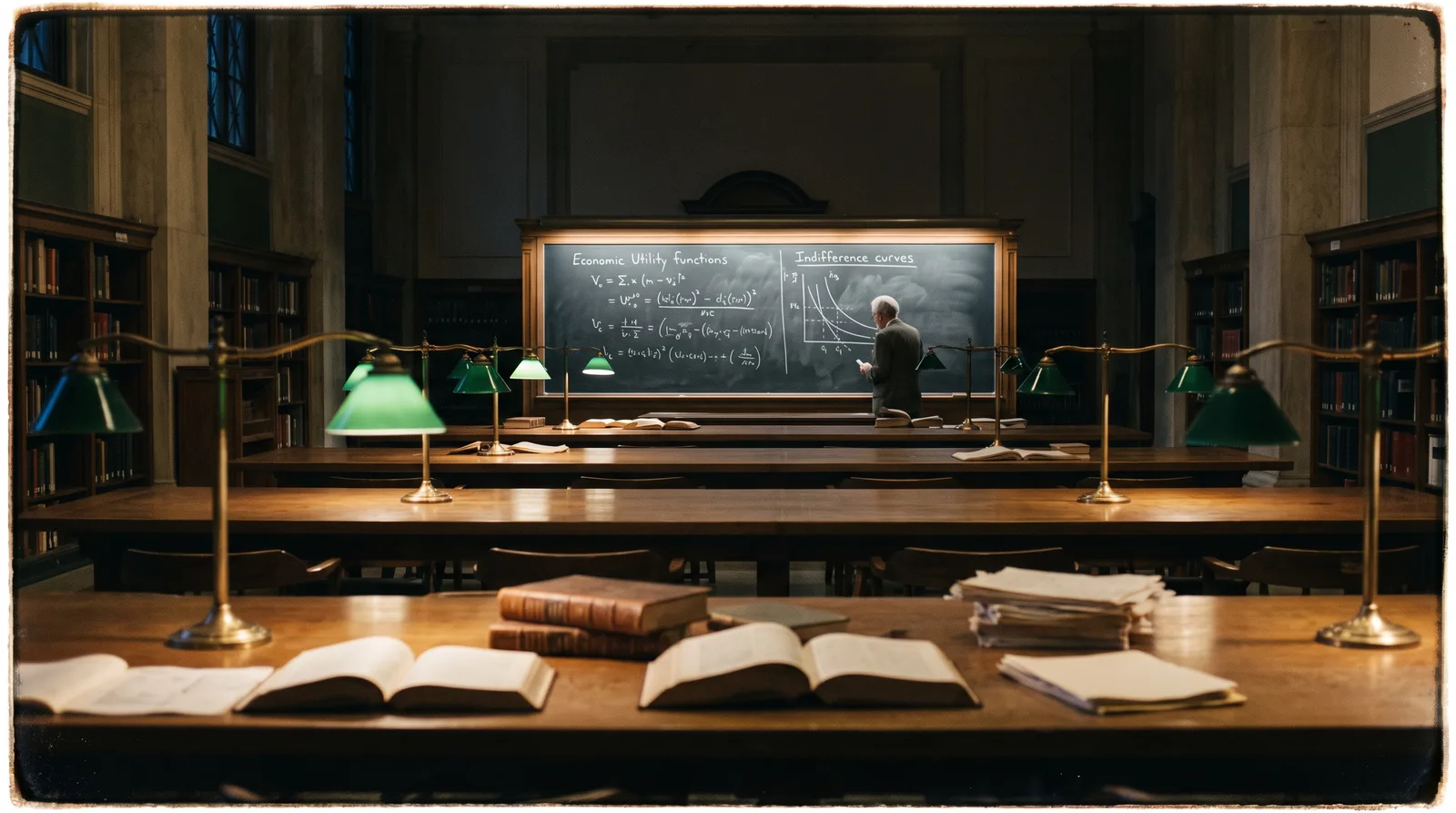
"The models are not the economy — they are a set of philosophical commitments dressed in mathematics, and you deserve to see the seams."
— Val (Valdas) Samonis
What you'll learn
What you'll be able to do
- Trace the arc of economic thought from Aristotle and moral philosophy through classical, Keynesian, and neoclassical schools to contemporary technocratic governance
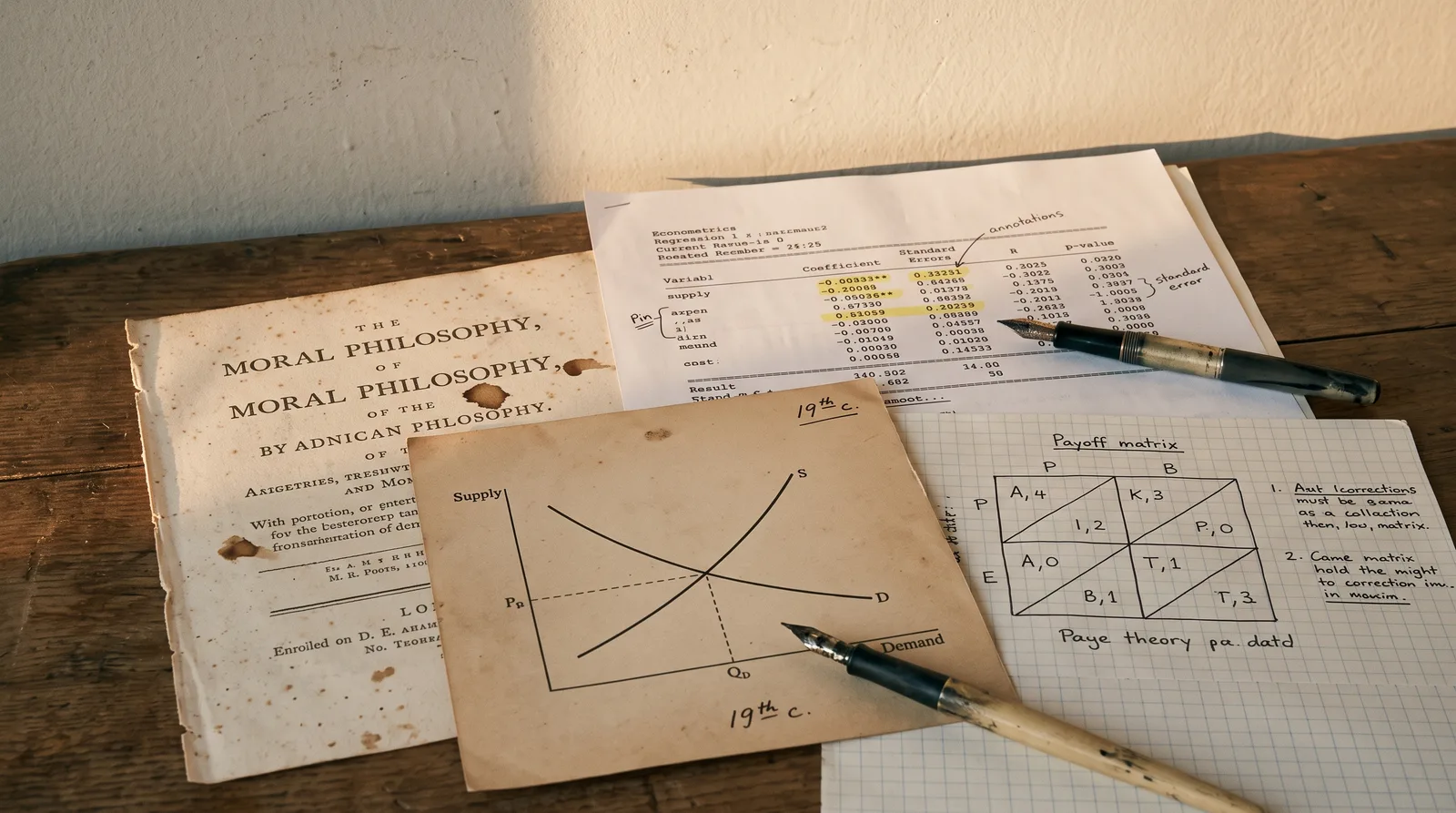
- Decode the mathematical formalism at the core of modern economics — utility functions, equilibrium models, and optimization — and explain what they assume and what they hide
- Critically evaluate the ideological and philosophical assumptions embedded in mainstream economic models
- Analyze how economics shifted from a humanities discipline into a quantitative 'hard science' and what was gained and lost in that transition
- Read and interpret landmark economic texts and papers — from The Wealth of Nations to Arrow's Impossibility Theorem — with confidence and context
- Apply an interdisciplinary lens to current economic policy debates, recognizing the technocratic, philosophical, and political dimensions at play
How it works
A school that adapts to you
This isn't a set of static videos. Every lesson is generated live and tuned to where you actually are.
We learn your level
A quick placement check tailors your starting point so you're never bored or lost.
Lessons adapt as you go
Each lesson is written for your pace and your goal, adjusting as your skills grow.
Your AI coach keeps you moving
Checkpoints, feedback, and gentle nudges turn progress into a real result.
The curriculum
What's inside your school
6 modules · 29 lessons

The Moral Roots of Economic Thought
Traces economics to its origins in ancient and Enlightenment moral philosophy, establishing the ethical foundations that classical thinkers believed economics must serve.
- 1.1Before 'Economics' Existed: Aristotle, Virtue, and the Just PriceIncluded
- 1.2Scholastic Economics and the Moral Economy of the Middle AgesIncluded
- 1.3The Mercantilist World: Wealth, Power, and the Nation-StateIncluded
- 1.4Adam Smith's Moral Universe: The Theory of Moral Sentiments and The Wealth of NationsIncluded
- 1.5Physiocrats and the Idea of Natural Economic OrderIncluded
Classical Economics and Its Discontents
Works through the classical tradition — Ricardo, Mill, Marx — and the political and philosophical battles that fractured it.
- 2.1Ricardo, Rent, and the Logic of DistributionIncluded
- 2.2Utilitarianism and the Birth of Welfare Thinking: Bentham and MillIncluded
- 2.3Marx's Critique: Labor, Value, and the Political Economy of CapitalIncluded
- 2.4The Socialist Calculation Debate: Can an Economy Be Planned?Included
The Marginalist Revolution and the Mathematization of Economics
Explains how the 1870s 'marginal revolution' transformed economics from political philosophy into a quantitative, formal discipline.
- 3.1The Marginal Revolution: Jevons, Menger, and WalrasIncluded
- 3.2Utility Functions and Indifference Curves: Reading the New Language of ChoiceIncluded
- 3.3General Equilibrium: Walras's Dream of a Self-Balancing EconomyIncluded
- 3.4What Mathematics Hid: Assumptions, Abstractions, and the Erasure of PowerIncluded
- 3.5Alfred Marshall and the Partial Equilibrium CompromiseIncluded
Keynes, the Neoclassical Synthesis, and the Age of Macroeconomics
Covers the Keynesian revolution, its absorption into the mainstream, and the contested terrain of macroeconomic policy it created.
- 4.1The Great Depression as Intellectual Crisis: Why Classical Theory FailedIncluded
- 4.2Keynes's General Theory: Uncertainty, Effective Demand, and Animal SpiritsIncluded
- 4.3The Neoclassical Synthesis: Hicks, Samuelson, and the IS-LM ReconciliationIncluded
- 4.4Monetarism and the Friedman Counter-RevolutionIncluded
- 4.5Stagflation, Rational Expectations, and the Fall of the Keynesian ConsensusIncluded
Landmark Texts, Formal Theorems, and the Limits of Formalism
Gives students direct encounters with canonical papers and theorems, building the skills to read and critique formal economic arguments.
- 5.1How to Read an Economics Paper: Structure, Assumptions, and InferenceIncluded
- 5.2Arrow's Impossibility Theorem: When Collective Choice Cannot Be RationalIncluded
- 5.3The Coase Theorem, Externalities, and the Limits of the Market LogicIncluded
- 5.4Game Theory and Strategic Interaction: Nash, Prisoners, and the Illusion of EquilibriumIncluded
- 5.5Behavioral Economics: Kahneman, Thaler, and the Challenge to Rational ChoiceIncluded
Technocracy, Power, and the Politics of Modern Economic Governance
Analyzes how economics became the language of governance, examining the institutions, ideologies, and blind spots of contemporary technocratic policymaking.
- 6.1The Rise of the Technocrat: How Economists Captured the StateIncluded
- 6.2The Washington Consensus: Neoliberalism as Global Economic DoctrineIncluded
- 6.3Central Banks, Independence, and the Depoliticization of Monetary PolicyIncluded
- 6.4Big Data, Algorithmic Policy, and the New Quantitative GovernanceIncluded
- 6.5Heterodox Alternatives and the Future of Economic PluralismIncluded
Who it's for
Is this you?

The self-taught intellectual
Deeply read outside formal academia, they want the rigorous, canonical framework that finally connects the economic thinkers they've encountered in scattered reading.

The policy professional
They work in or around government and want the intellectual history and philosophical grounding to move beyond technocratic talking points in their field.

The graduate student
Trained in a narrow specialization, they're hungry for the panoramic history of economic thought their methods-heavy program never provided.

The disillusioned economist
Formally trained but increasingly aware of what the mainstream models hide, they want the critical vocabulary and historical depth to think beyond the consensus.
The engaged citizen
Frustrated by economic debates they can follow but not truly evaluate, they want the conceptual tools to read behind the headlines and hold power to account.

The lifelong learner
A professional in a non-economics field who reads widely and wants a course that meets them at their intellectual level — serious, historical, and genuinely challenging.
Questions
Frequently asked
Your teacher
A note from your teacher
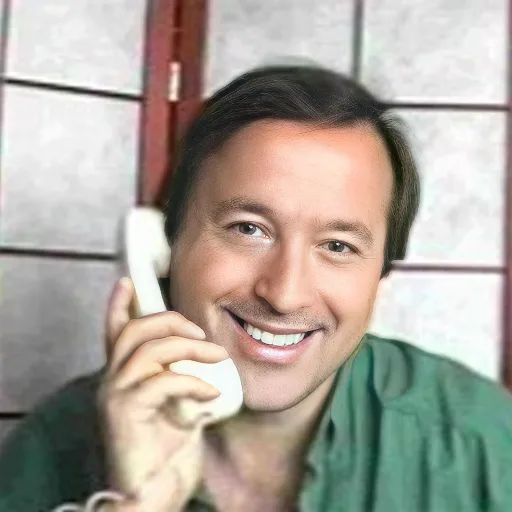
Val (Valdas) Samonis
If you've ever sat through an economics lecture and felt that something important was being left out — some context, some history, some acknowledgment that these models are choices, not facts of nature — then you already understand why I built this course.
Economics is taught, almost everywhere, as a set of tools. Here is how to model a market. Here is how to optimize a utility function. Here is the equilibrium condition. Master the technique, pass the exam. And the technique is real — I am not dismissing it. But technique without intellectual history is like reading a constitution without knowing anything about the revolution that produced it. You can parse the sentences, but you cannot understand what they mean or why anyone fought over them.
What I want to give you is something rarer: the ability to read the entire tradition. To understand why Adam Smith was first a moral philosopher, and what that meant for everything he wrote about markets. To see what was genuinely revolutionary — and what was quietly ideological — about the marginalist mathematization of the 1870s. To grasp why Keynes's intervention after the Great Depression was not just a technical adjustment but a philosophical rupture, and why the neoclassical synthesis that followed him was, in some ways, a managed retreat from that rupture. To sit with Arrow's Impossibility Theorem and feel its full weight: the formal proof that no voting system can consistently aggregate individual preferences into a coherent social choice. These are not footnotes to economics. They are economics, at its most honest.
The course is demanding. We read primary texts, not just summaries of them. We engage with formal models, but we also interrogate their assumptions. We take Marx seriously as an economic thinker — not because I'm asking you to be a Marxist, but because his critique of classical political economy is one of the most rigorous and consequential in the history of the discipline, and you cannot claim to understand that history while skipping it. We end in the present: the technocratic world of independent central banks, algorithmic governance, and global financial institutions that make decisions of enormous political consequence while presenting themselves as practitioners of neutral science. You should know how that world was built.
I believe that the most important thing economics education can do right now is produce people who can think about economic ideas, not just within them. Every major policy question of our time — inequality, climate, trade, monetary policy, the future of work — is saturated with economic assumptions that most citizens never get the chance to examine. This course is my attempt to change that, one student at a time. Come prepared to think hard, read carefully, and argue precisely. That's all I ask.
— Val (Valdas) Samonis
Start your journey today
Get instant access — learn at your own pace with an AI coach in your corner.
$59/mo
Recurring billing · cancel anytime
Secure checkout · Instant access
- 6 modules, 29 lessons
- AI-adaptive lessons tuned to your level
- Quizzes & checkpoints to lock in progress
- Your own AI learning coach
- Learn on any device, at your pace
- Full access for as long as you're subscribed